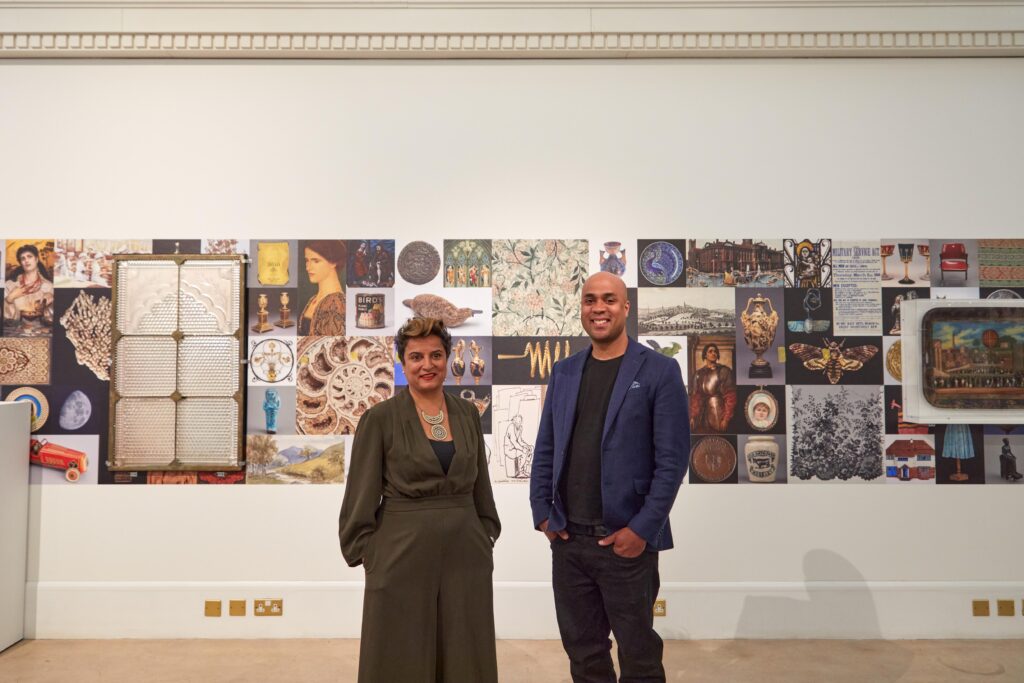
Sara Wajid and Zak Mensah, Co-CEOs of Birmingham Museums Trust
Many in the UK cultural sector will already be familiar with co-leadership in the form of the Artistic Director / Executive Director co-CEO model which theatres have used for nearly 50 years. Co-leaders share overall responsibility for organisational strategy and performance, whilst each also leads different areas. This model evolved as the management of cultural organisations became more complex in the late 1980s and ensures the overall strategy balances artistic and business considerations.
The recent past has seen an explosion in interest in co-leadership across other sectors internationally and new experiments in co-leadership in the UK cultural sector in response to an increasingly challenging operating context and an urgency to increase diversity. Recent adopters of co-leadership in the cultural sector are experimenting with less familiar models including co-CEO part-time job-shares; co-CEO models that avoid the executive/artistic binary and co-AD models. Across the UK cultural sector organisations are recruiting co-leaders for the first time, for example the appointment of Zak Mensah and Sara Wajid at Birmingham Museums Trust who are the first co-CEOs of a major museum group. The Royal Shakespeare Company announced the appointment of its first co-Artistic Directors in 2022, following a growing trend that includes Clean Break, Royal Exchange Manchester, Diverse City and Paines Plough among others. Sometimes co-leaders job-share, working part-time around caring/parenting responsibilities or external artistic projects, other times the co-CEOs are both full-time roles.
Internationally co-leadership is beginning to be viewed by commentators in healthcare, higher education, business, and non-profits and as a vehicle for enabling greater diversity in leadership. Others go further still, suggesting co-leadership enables a more inclusive organisational culture and offers an alternative to highly gendered leadership norms. In the business sectorco-leadership has been found to offer competitive advantage and improved profitability and performance by widening the leadership capabilities and perspectives available to organisations facing unparalleled challenges in this VUCA (volatile, uncertain, complex and ambiguous) operating environment.
This autumn I received support from the Clore Leadership Programme and Arts and Humanities Research Council to undertake research explored the potential of co-leadership to increase leadership diversity.
Join us online for a panel discussion exploring how co-leadership works on 14 March, chaired by Sandeep Mahal MBE and including speakers from four of the case study organisations:
Euella Jackson – co-Director of Rising Arts Agency
Niels de Vos – Chair, Birmingham Museums Trust
Anna Herrmann – Artistic Director and join CEO, Clean Break Theatre
Parminder Dosanjh and Sajida Carr – Co-Directors, Creative Black Country
I’ll be launching a new User Guide including advice for boards on the 14th March – in the meantime if you’d like a copy of the full report, or Executive Summary, you can find this below.
Those in leadership positions in the publicly funded arts and cultural sector do not fully reflect the demographic diversity of the UK. The report on Social Mobility in the Cultural Economy from the Creative Industries Policy and Evidence Centre (September 2021) cites evidence of inequality and exclusion in the creative industries in the UK, which has been created through class, gender, race, disabilities, skills and place. It recommends accelerating progression of diverse talent and promoting inclusive leadership, to ensure that the creative leaders of the future are much more diverse. The reasons for under-representation at a leadership level are many and complex. This research proposes to focus on the role that adapting leadership models could play in changing who takes up and is appointed to senior roles in the cultural sector.
What is already known about co-leadership in the cultural sector?
Ten years ago I undertook a research project as part of my Clore Fellowship to explore joint leadership by Artistic and Executive Directors. In this report I concluded a co-leadership model can work very well for organisations where a wide range of skills are needed at a senior level. In a volatile and complex world, having a ‘sounding board’ with whom to develop ideas and share challenges was another advantage. And when it was time for one of the co-leaders to move on, having a joint leadership model offered stability. I concluded ‘two heads are better than one’; so long as leaders have the competencies needed to collaborate, and accountability and values are shared. In the intervening decade there have been a few examples of new co-leadership models and appointments in the cultural sector, such as Sara Wajid and Zak Mensah at Birmingham Museum and Art Gallery, but as yet this model is still not widely understood or practiced.
When I undertook my original research, the range of competencies expected in a CEO and the complexity of cultural organisations’ financial, political and operational context was already becoming unrealistic. Since then leadership roles have only become more demanding and we have seen an increase in leaders stepping down from roles which come at too high a cost to their health and personal life. These intense working conditions impact leaders with caring responsibilities, health issues or disabilities most keenly. As a leadership development professional I regularly meet leaders who chose not to apply for these roles in the first place, because of the demands of the roles and others who, due to structural racism, ableism or sexism in the cultural sector, have been unable to develop the experience Boards expect of those applying for senior roles today.
Moreover, I work with Boards that, whilst recognising the need to broaden the profile of who they recruit into senior roles, see job-sharing or co-leadership roles as inherently more risky or costly. Some hold heroic and unrealistic assumptions about ‘what it takes’ to successfully lead an organisation in terms of working patterns or personal resilience that prevent real workforce change happening. There is a long way to go before more Boards are see co-leadership as an opportunity.
How can you get involved?
Building on my initial research, and the wider leadership literature around co-leadership, I wish to examine whether co-leadership, including the AD/ED model but more widely other forms of shared senior roles, offers a practical solution to increasing the diversity of who applies for, and is appointed to, senior leadership positions in the cultural sector.
I will be working on this research during Autumn/ Winter and publishing my findings in February. There will also be an event to share the discuss the findings around February/ March, hosted by the Office for Leadership Transition – and I’ll share details of this nearer the time.
At this stage I am looking for suggestions of people to speak with as part of my research, particularly
those involved in recruitment of senior leadership roles in a Board capacity, and,
women, people with disabilities and people of colour who aspire to or have experience of senior leadership positions.
If this is you, or have suggestions of who I might talk to please do get in touch – thank you!
This research has been funded by the Arts and Humanities Research Council (AHRC), in conjunction with the Clore Leadership Programme. I am being supervised by Dr Jonathan Price, School of Performance and Creative Industries, University of Leeds.
We use cookies on our website to give you the most relevant experience by remembering your preferences and repeat visits. By clicking “Accept”, you consent to the use of ALL the cookies.
This website uses cookies to improve your experience while you navigate through the website. Out of these, the cookies that are categorized as necessary are stored on your browser as they are essential for the working of basic functionalities of the website. We also use third-party cookies that help us analyze and understand how you use this website. These cookies will be stored in your browser only with your consent. You also have the option to opt-out of these cookies. But opting out of some of these cookies may affect your browsing experience.
Necessary cookies are absolutely essential for the website to function properly. These cookies ensure basic functionalities and security features of the website, anonymously.
Cookie
Duration
Description
cookielawinfo-checbox-analytics
11 months
This cookie is set by GDPR Cookie Consent plugin. The cookie is used to store the user consent for the cookies in the category "Analytics".
cookielawinfo-checbox-functional
11 months
The cookie is set by GDPR cookie consent to record the user consent for the cookies in the category "Functional".
cookielawinfo-checbox-others
11 months
This cookie is set by GDPR Cookie Consent plugin. The cookie is used to store the user consent for the cookies in the category "Other.
cookielawinfo-checkbox-necessary
11 months
This cookie is set by GDPR Cookie Consent plugin. The cookies is used to store the user consent for the cookies in the category "Necessary".
cookielawinfo-checkbox-performance
11 months
This cookie is set by GDPR Cookie Consent plugin. The cookie is used to store the user consent for the cookies in the category "Performance".
viewed_cookie_policy
11 months
The cookie is set by the GDPR Cookie Consent plugin and is used to store whether or not user has consented to the use of cookies. It does not store any personal data.
Functional cookies help to perform certain functionalities like sharing the content of the website on social media platforms, collect feedbacks, and other third-party features.
Performance cookies are used to understand and analyze the key performance indexes of the website which helps in delivering a better user experience for the visitors.
Analytical cookies are used to understand how visitors interact with the website. These cookies help provide information on metrics the number of visitors, bounce rate, traffic source, etc.
Advertisement cookies are used to provide visitors with relevant ads and marketing campaigns. These cookies track visitors across websites and collect information to provide customized ads.


Recent Comments